
From the Olympics to the Boardroom: Why Investing in Women Works
I have been fascinated by the Olympics for as long as I can remember. I attended the 1980 Winter Olympics for a day in Lake Placid, and it felt like magic - people wandering through that small, charming town from all over the world while ski jumpers did insane things in the distance. I’ve met and watched winter Olympians train in Lake Placid and even visited the Olympic museum in Switzerland. I can’t get enough.
When the Winter Olympics started in Italy this February, I watched as much as I could. I’ve always loved ice skating and skiing, and my husband - a marathon runner - turned me on to cross-country ski racing, the ultimate endurance sport.
My heart was captured by Amber Glenn, the American figure skater. She didn’t win a medal, but she stole my heart. Figure skating is a brutal sport for perfectionists: everything has to be perfect, or you don’t win. As a perfectionist in recovery, just imagining that pressure gives me anxiety.
Amber’s journey - from three-time U.S. champion, to stepping away at 16 due to depression, anxiety, and an eating disorder, to returning at 21, falling short, returning again, and skating a long program in Italy that outscored the gold medalist’s - took my breath away. She didn’t win a medal, but she won something bigger: she showed us what courage looks like.
Amber reminded me that hiding your fears doesn’t work. Showing up as yourself, giving yourself grace, and trying again does.
I celebrate Amber’s courage during Women’s History Month. Her story of persistence echoes the stories of women who fought for the right to vote, to get a credit card, to attend Harvard Business School, and to have equal opportunity to play sports.
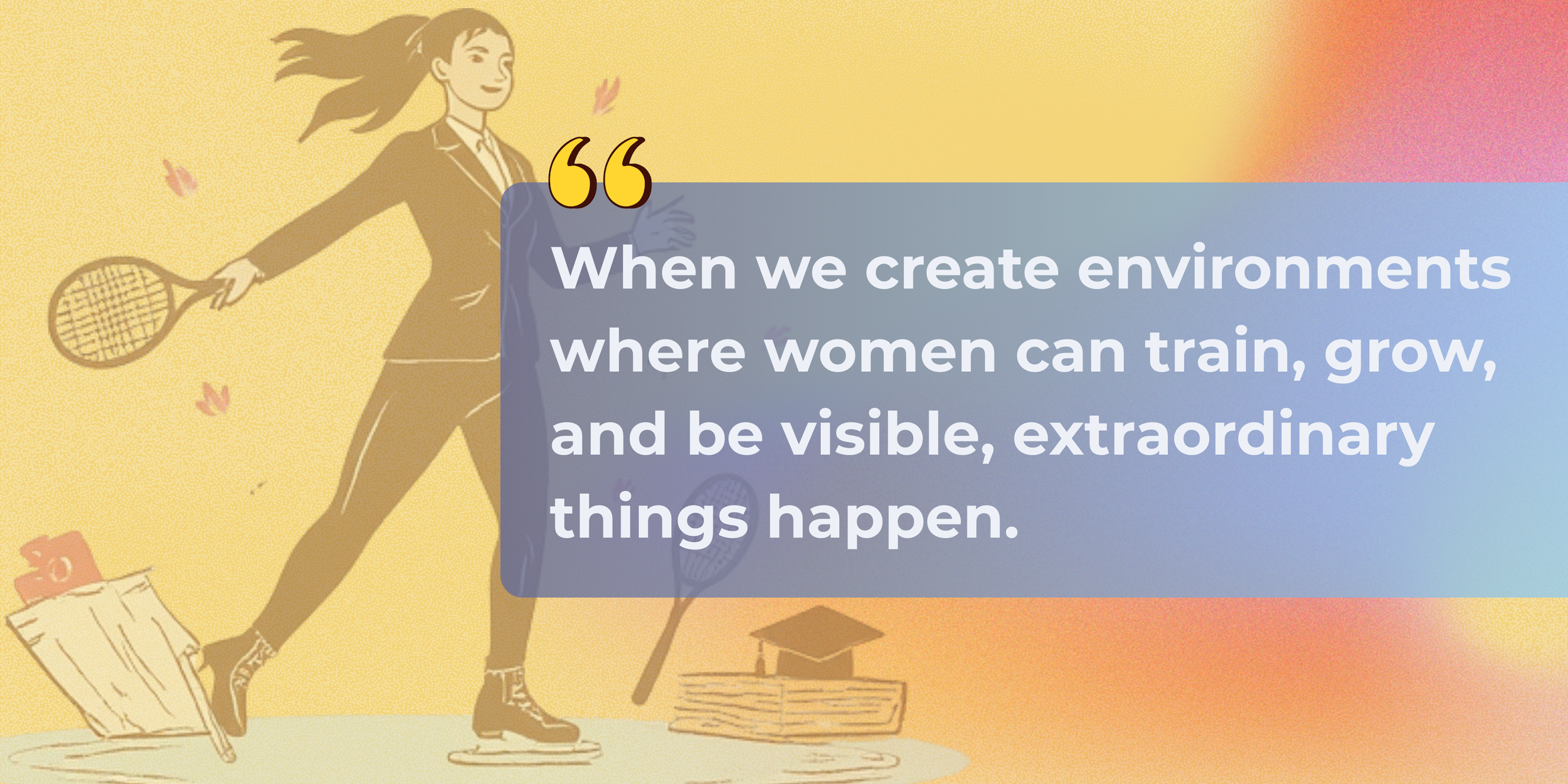
I still remember that Title IX, passed in 1972, allowed me to have equal access to tennis, which eventually led to playing in high school and college. My mother’s generation, and even women just five years older than me, had very few opportunities to play sports growing up. Title IX is one of those unsung laws that quietly changed everything. It created decades of access to both education and athletics. And look what happens when you remove obstacles and provide equal access to women.
American women once again led Team USA at the 2026 Winter Olympics, earning 17 medals to the men’s 12, including six golds - the sixth consecutive Olympics in which women outperformed men. Their dominance wasn’t a surprise; it was the predictable result of decades of investment, coaching, and opportunity. Title IX created a pipeline in which girls grew up expecting to compete, train seriously, and win. That long-term commitment shows up on the medal stand.
Now imagine if we applied that same level of investment to women in science, engineering, and finance.
A new 2025 book by McKinsey, The Broken Rung, makes it painfully clear how much work remains. The authors show that, despite decades of progress, the corporate pipeline remains structurally uneven for women. Every rung has cracks, but the very first step up to manager remains the most consequential - and the most unequal.
For every 100 men who receive that first promotion, only 81 women do. Not because women lack ambition - in fact, the research shows they express equal or greater desire to lead - but because they are given fewer stretch assignments, fewer early leadership opportunities, and fewer chances to be seen.
As someone who mentors and coaches women in STEM and finance, I see the impact of this every day. The Olympics remind me that talent is everywhere - opportunity is not. When we create environments where women can train, grow, and be visible, extraordinary things happen.
Watching these Games reminded me how powerful it is when someone believes in you - and how far women can go when the path is open. It makes me hopeful about what’s possible in our workplaces when we choose to create that same sense of access and belief.
I’ll keep doing my part through coaching and mentoring, and I hope this moment inspires all of us to look for the women in our orbit who are ready for their next step. When we invest in them, we don’t just change careers - we change what’s possible.
I would love to hear: What are you and/or your organizations doing to invest in women right now?